|
| MOQ: | 500 meters |
| Price: | $3.50/meters 500-800 meters |
| Supply Ability: | 1000000 Meter/Meters per Month |
Moisture Resistant Interior Drywall Solution
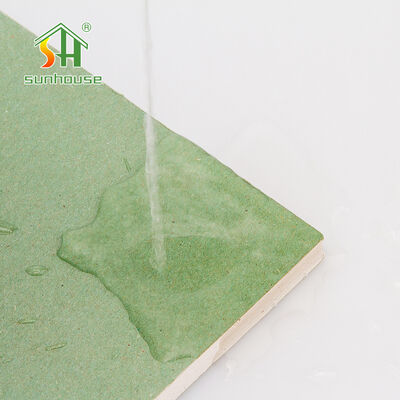
This 18mm moisture resistant gypsum board is designed for indoor wall systems, drywall partitions and wall lining projects where builders need better humidity tolerance, stable board strength, smooth finishing quality and efficient installation. With a standard board size of 1220×2440mm, it is suitable for commercial interiors, residential renovation, utility areas, hotel back-of-house spaces and controlled-humidity indoor environments.
In many indoor projects, standard drywall is not always enough. Walls near kitchens, service corridors, utility rooms, storage areas or high-traffic commercial interiors may face occasional humidity, temperature changes, frequent maintenance and impact from daily use. Moisture resistant gypsum board helps solve these practical problems while keeping the advantages of drywall construction: lighter weight, faster installation and a smooth finish-ready surface.
For indoor areas where occasional moisture or higher humidity may affect ordinary gypsum board performance.
18mm thickness provides a stronger and more solid board option for wall lining and partition systems.
Drywall installation reduces wet work and supports cleaner, faster project delivery compared with traditional masonry work.
Paper-faced surface is suitable for jointing, skim coating, painting and decorative wall finishes.
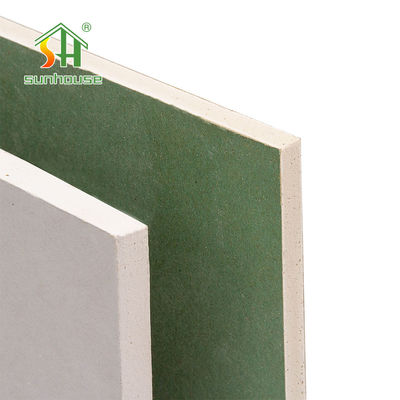
Moisture Resistant Gypsum Board is a paper-faced drywall sheet made with a treated gypsum core and durable facing paper. Compared with regular gypsum board, the moisture resistant version is developed for indoor spaces where the board may be exposed to controlled humidity or occasional moisture in the air.
The 18mm thickness makes this board suitable for applications where buyers need better rigidity, improved wall feel and stronger board performance than thinner drywall sheets. The 1220×2440mm sheet format offers approximately 2.98m² coverage per board, making it convenient for material calculation, container loading and jobsite installation planning.
This board is not intended for direct water exposure, outdoor installation or areas requiring full waterproofing. For bathrooms, wet rooms or water-splash zones, it should be used only as part of a complete moisture-control system, including waterproof coating, sealant, ventilation and suitable surface finishing.
The treated gypsum core helps improve resistance to moisture-related board softening in controlled indoor environments. It is suitable for utility rooms, kitchens, service corridors and other spaces where regular boards may not be the best choice.
The 18mm board thickness provides a more solid panel option for indoor walls and partitions. It is useful for projects requiring better stiffness, stronger wall feel and improved durability during installation and daily use.
Compared with brick or block walls, drywall board systems are lighter and easier to modify. This helps reduce structural load, improve construction speed and support flexible interior layout changes.
The paper-faced surface supports standard drywall finishing, including joint treatment, skim coating, primer, paint, wallpaper and other interior decorative finishes.
The board can be cut and installed with common drywall tools. It is suitable for light steel framing systems, wall lining structures and partition applications.
The standard 1220×2440mm size helps contractors estimate board quantities, reduce cutting waste and simplify procurement for repeated wall modules.
The following data is prepared for product page reference and procurement communication. Final values should be confirmed according to the actual factory test report, project standard and order specification.
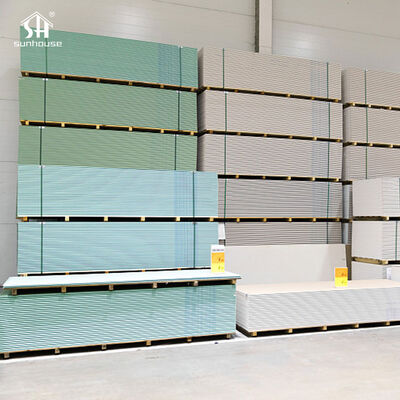
Recommended for general ceiling, wall lining, and partition applications in dry indoor areas such as offices, schools, apartments, retail stores, and public buildings.
Designed for wall and ceiling assemblies where improved fire performance is required. It is commonly used in corridors, stairwells, service areas, commercial buildings, and projects with specified fire-rated system requirements.
Suitable for indoor areas with controlled humidity, such as kitchens, utility rooms, and selected commercial interiors. It should be used together with appropriate finishing and waterproofing measures where required by the project design.
In a hotel corridor renovation project, the contractor selected paper gypsum board for a suspended ceiling system because the material allowed faster installation and easier access for lighting, ventilation, and maintenance points. A smooth painted finish was required, and the paper-faced surface provided a suitable base for jointing and final decoration.
For a multi-room office layout, gypsum board partitions were used with light steel framing to reduce construction weight and shorten the fit-out schedule. The system allowed flexible routing of electrical and data cables inside the cavity, while double-layer board construction was considered for meeting rooms requiring better acoustic performance.
In an education building project, gypsum board was used for classrooms, corridors, and administrative areas. The main project requirements were stable surface quality, controlled board weight, ease of repair, and compatibility with painted finishes. Fire-resistant board options were reviewed for specific areas according to the project design.
For contractors, distributors, and project buyers, gypsum board selection should be based on measurable performance rather than only product appearance. Density affects handling and system weight. Flexural strength influences board stiffness and installation reliability. Fire stability, water absorption, and radioactivity indexes help determine whether the board is suitable for specific project environments.
The supplied test values show that the 12mm board reaches 700 N parallel flexural strength and 240 N cross flexural strength, while the 9.5mm board reaches 560 N parallel flexural strength and 180 N cross flexural strength. These figures provide useful reference points for procurement evaluation and project comparison.
Paper gypsum board is mainly used for interior ceilings, partition walls, wall lining, and decorative building systems. It is suitable for hotels, offices, schools, shopping malls, residential buildings, cinemas, studios, and other indoor construction projects.
Gypsum has natural fire-resistant properties because it contains chemically combined water. Fire-resistant gypsum board can help improve fire performance when used in a properly designed wall or ceiling system. The final fire rating depends on the complete tested assembly.
Regular gypsum board is recommended for dry indoor areas. For controlled humid environments, water-resistant gypsum board should be selected. It is important to note that water-resistant gypsum board is not the same as waterproof board and should not be directly exposed to continuous water.
Common ceiling board thicknesses include 9mm, 9.5mm, 12mm, and 12.5mm, depending on the ceiling system, framing spacing, board type, and local installation practice.
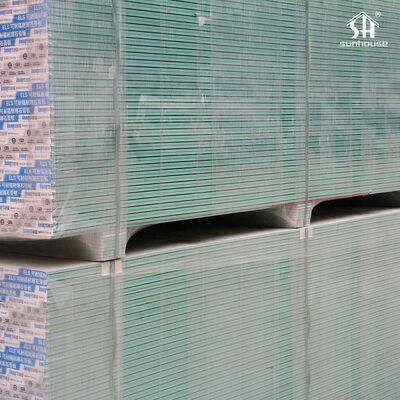
Boards should be stored flat on a dry, level surface and protected from rain, standing water, and high humidity. Proper storage helps prevent board deformation and paper surface damage before installation.
 english
 français
 Deutsch
 Italiano
 Русский
 Español
 português
 Nederlandse
 ελληνικά
 日本語
日本語
 한국
한국
 العربية
 हिन्दी
 Türkçe
 indonesia
 tiếng Việt
 ไทย
ไทย
 বাংলা
বাংলা
 فارسی
فارسی
 polski