|
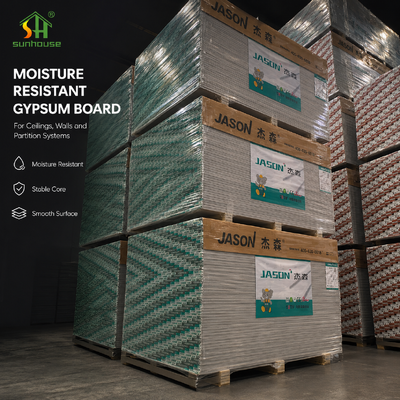
| Brand Name: | SUNHOUSE |
| Model Number: | 1220x244m-12mm |
| MOQ: | 800 |
| Payment Terms: | L/C,T/T |
Bathrooms are often treated as one moisture category, but the actual exposure level can change significantly from one part of the room to another.
A wall beside a vanity, a bathroom ceiling, a partition near a shower and a surface receiving direct water should not automatically be specified with the same board system.
Buyers frequently receive product descriptions stating that moisture-resistant gypsum board is suitable for bathrooms. The problem is that a bathroom contains several very different environments.
Some surfaces are exposed mainly to indoor humidity, while others may receive condensation, occasional splashes or repeated direct water exposure.
The correct specification depends on where the panel will be installed and what complete wall or ceiling system will protect it.
Areas inside or adjacent to the bathroom that experience normal indoor humidity but little direct moisture exposure.
Areas exposed to repeated humidity, condensation or occasional splash without continuous direct water.
Surfaces that may receive repeated or sustained direct water exposure during normal use.
| Bathroom Area | Typical Exposure | Purchasing Consideration |
|---|---|---|
| Bathroom Entrance Wall | Normal interior humidity | Standard or moisture-resistant board may be considered according to the wall specification. |
| Vanity Area | Humidity and occasional splash | Moisture-resistant plasterboard is commonly considered for suitable interior systems. |
| Bathroom Ceiling | Steam, condensation and high humidity | Check moisture resistance together with thickness, support spacing and ceiling requirements. |
| Behind a Sink | More frequent splash exposure | Surface finish, joint treatment and local water protection become more important. |
| Shower Wall | Repeated direct water | Do not assume moisture-resistant gypsum board alone provides a complete waterproof substrate. |
| Wet Room | High and repeated direct-water exposure | A complete wet-area system or specialist substrate may be required. |
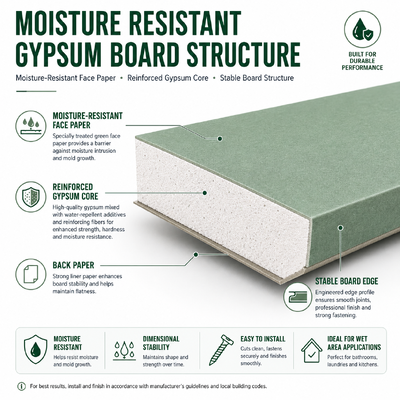
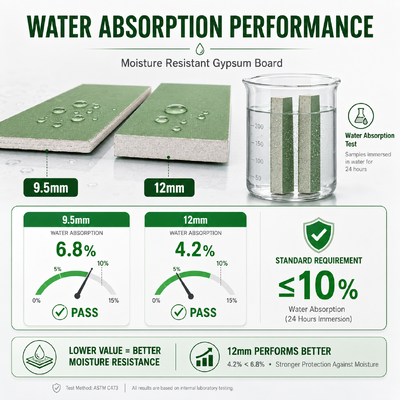
Moisture-resistant gypsum board is designed to perform better than standard drywall in suitable humid interior conditions. That does not mean the board should be treated as a waterproof barrier.
Direct-water areas should be evaluated as a complete system, including substrate, waterproofing, joints, penetrations, tile finish and installation details.
Bathroom ceilings are usually not exposed to direct shower water, but they can experience repeated steam, warm humid air and condensation.
Buyers should therefore consider both the moisture-resistant board and the ceiling system supporting it.
A shower enclosure receives much more aggressive moisture exposure than a general bathroom partition. Repeated water spray can reach joints, corners, penetrations and tile interfaces.
| Shower Wall Risk | Why It Matters |
|---|---|
| Direct Water Spray | Repeated water exposure is more demanding than general bathroom humidity. |
| Tile Joints | Tile surfaces alone should not be assumed to eliminate all moisture movement. |
| Pipe Penetrations | Openings around mixers, shower heads and services require careful treatment. |
| Internal Corners | Corners and wall-to-floor junctions are critical parts of wet-area systems. |
| Hidden Leakage | Water reaching the substrate can cause damage before it becomes visible externally. |
This prevents the plasterboard specification from being considered separately from waterproofing and the finished wall assembly.
Many bathroom wall systems use ceramic or porcelain tiles over a prepared substrate. Buyers should still confirm whether the selected substrate and waterproofing system are appropriate for the expected exposure.
A bathroom partition may have a humid bathroom on one side and a dry bedroom, corridor or service space on the other.
The board specification therefore needs to match the exposure and finishing requirements on each face of the partition.
| Partition Condition | Buyer Focus |
|---|---|
| Bathroom to Bedroom | Moisture exposure may be concentrated on the bathroom-facing side. |
| Bathroom to Corridor | Check moisture requirements together with fire and acoustic performance if required. |
| Bathroom Service Wall | Plumbing penetrations can increase hidden moisture risk. |
| Hotel Bathroom Partition | Repeated use may create more frequent humidity cycles than residential rooms. |
| Application | Main Purchasing Priority |
|---|---|
| Residential Bathroom | Correct moisture-resistant board selection for general humid wall and ceiling areas. |
| Hotel Washroom | Repeated humidity cycles, partition requirements and durable finishing. |
| Apartment Bathroom | Consistent specification across large quantities of repetitive units. |
| Commercial Washroom | Moisture performance together with fire, durability and maintenance requirements. |
| Shower Enclosure | Direct-water exposure requires evaluation of the complete wet-area system. |
Moisture-resistant plasterboard can be a practical solution for many bathroom walls, partitions and ceilings, but “bathroom use” alone is not a complete specification.
Buyers should first identify whether the board will face normal indoor humidity, repeated condensation, occasional splash or direct water exposure.
The more severe the exposure, the more important it becomes to evaluate the complete substrate, waterproofing, finishing and installation system rather than the board alone.
Send us your required thickness, board size, bathroom application, wall or ceiling use, finishing method and destination project. Suitable moisture-resistant gypsum board specifications can be matched according to the actual interior exposure conditions.
Request Bathroom Board Specification english
 français
 Deutsch
 Italiano
 Русский
 Español
 português
 Nederlandse
 ελληνικά
 日本語
日本語
 한국
한국
 العربية
 हिन्दी
 Türkçe
 indonesia
 tiếng Việt
 ไทย
ไทย
 বাংলা
বাংলা
 فارسی
فارسی
 polski