|
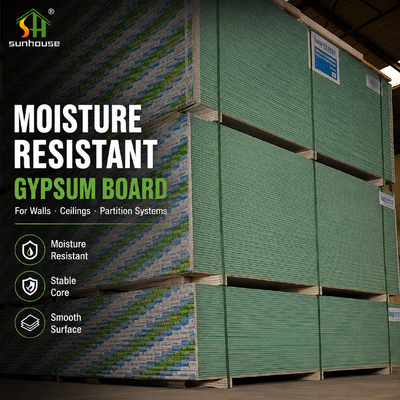
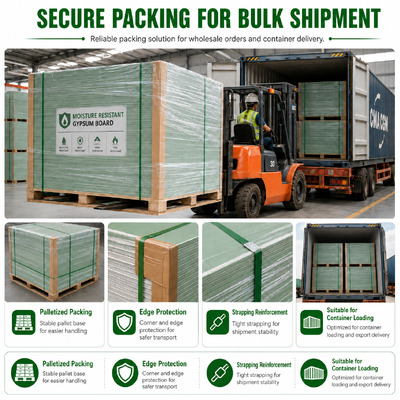
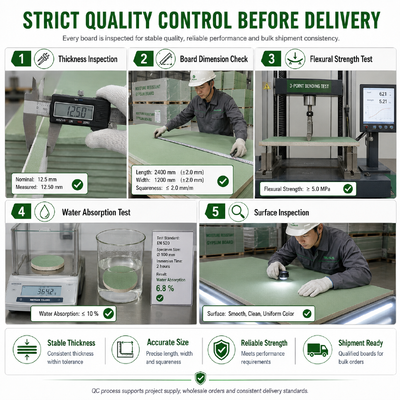
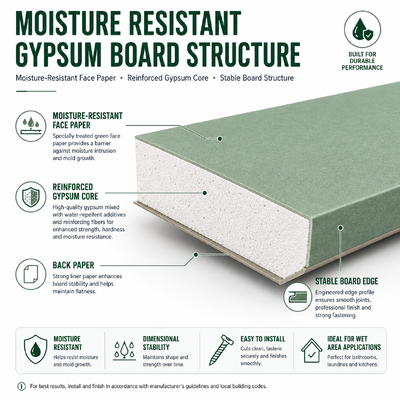
| Brand Name: | SUNHOUSE |
| Model Number: | 1220x244m-12mm |
| MOQ: | 800 |
| Payment Terms: | L/C,T/T |
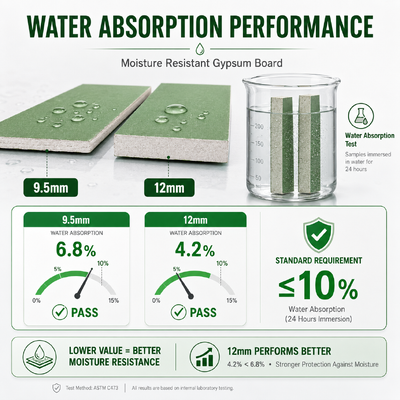
Two gypsum panels may both be described as suitable for humid interiors, yet their measured moisture performance may not be identical.
For professional buyers, the useful question is not simply whether the board is called moisture resistant. Buyers should understand what was tested, how the test was performed and what result applies to the actual product.
Suppliers often use phrases such as low water absorption, water resistant or suitable for humid environments. These descriptions can be useful for product positioning, but they do not provide enough information for technical purchasing.
Buyers need to know whether the reported value relates to the complete board, the surface, a specific exposure period or another test condition.
A lower-looking value from one test method should not automatically be treated as better than a higher value obtained using another method.
Confirm whether the result relates to total board water uptake, surface absorption or another moisture-performance measurement.
Check the referenced test method, sample preparation, exposure conditions and evaluation procedure.
Confirm the board type, thickness and product identification correspond with the material being quoted.
| Performance Item | What It Evaluates | Why Buyers Care |
|---|---|---|
| Surface Absorption | Evaluates how the board face responds to moisture under the specified test conditions. | Useful when comparing the performance of the finished facing surface. |
| Total Water Uptake | Evaluates moisture absorbed by the complete test specimen under the stated method. | Provides information about the board as a complete material system. |
| Humidity Exposure | Evaluates panel behavior under humid environmental conditions where applicable. | Relevant to bathrooms, ceilings and other high-humidity interior applications. |
Surface absorption, complete-board water uptake and high-humidity performance describe different aspects of panel behavior.
| Item | Better Buyer Check | Weak Purchasing Method |
|---|---|---|
| Product | Confirm the exact gypsum wallboard tested | Assume every green panel has the same result |
| Thickness | Match tested thickness with quoted product where relevant | Ignore differences between test sample and order |
| Method | Confirm how the value was measured | Compare percentages without checking method |
| Result | Review the actual measured value | Only read promotional wording |
| Requirement | Understand what limit the value is compared against | Treat “Pass” as the complete technical specification |
Different gypsum core formulations can influence how the complete panel responds to moisture.
Surface-paper construction and treatment can influence face-side moisture performance.
Differences in board construction can influence physical behavior and finished panel properties.
Production consistency affects whether different batches continue to meet the intended specification.
Cut edges and damaged areas do not have exactly the same protection as an intact finished face.
Different procedures, exposure periods and sample preparation can produce results that should not be compared directly.
Gypsum wallboard is installed by cutting sheets, forming openings and creating joints. This means the completed wall contains more than untouched factory-finished surfaces.
Cut edges, damaged corners, service penetrations and poorly finished joints may become more vulnerable locations when exposed to moisture.
A good board specification cannot compensate for permanently exposed edges, leaking pipes or repeated direct-water penetration.
Simple demonstrations can help buyers visually compare samples, but pouring water onto two boards does not automatically provide a reliable technical comparison.
| Simple Test Problem | Why Results Can Be Misleading |
|---|---|
| Different Water Quantity | The samples may not receive the same exposure. |
| Different Exposure Time | One board may remain wet much longer than another. |
| Face vs Edge | Water applied to a finished face is different from exposing a cut edge. |
| No Weight Measurement | Visual appearance alone does not quantify water uptake. |
| No Controlled Conditions | Results can change with sample size, temperature and preparation. |
When a project specifies a particular moisture-performance level, buyers should rely on the relevant test information and agreed acceptance criteria.
| Specification | Buyer Should Confirm |
|---|---|
| Panel Type | Exact gypsum panel category being supplied. |
| Board Size | Width, length and dimensional requirements. |
| Thickness | Nominal thickness and applicable tolerance. |
| Water Uptake Data | Applicable test method and measured result. |
| Surface Performance | Relevant face-side moisture information where required. |
| Application | Wall, partition, bathroom or ceiling use. |
| Supporting Information | Product data and required test documentation. |
A professional gypsum wallboard comparison should go beyond labels such as water resistant, low absorption or green board.
Buyers should identify the test method, the type of moisture measurement, the actual measured result and the product specification represented by that result.
This makes supplier comparison more meaningful and helps prevent two technically different products from being treated as if they offer the same moisture performance.
Send us your required board thickness, dimensions, wall or ceiling application, destination market and moisture-performance requirement. Suitable gypsum panel specifications and available test information can be matched for bathrooms, kitchens, washrooms and other humid interior projects.
Request Test Data & Board Specification english
 français
 Deutsch
 Italiano
 Русский
 Español
 português
 Nederlandse
 ελληνικά
 日本語
日本語
 한국
한국
 العربية
 हिन्दी
 Türkçe
 indonesia
 tiếng Việt
 ไทย
ไทย
 বাংলা
বাংলা
 فارسی
فارسی
 polski