|
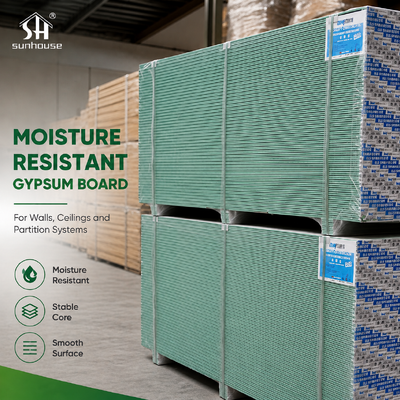
| Brand Name: | SUNHOUSE |
| Model Number: | 1220x244m-12mm |
| MOQ: | 800 |
| Payment Terms: | L/C,T/T |
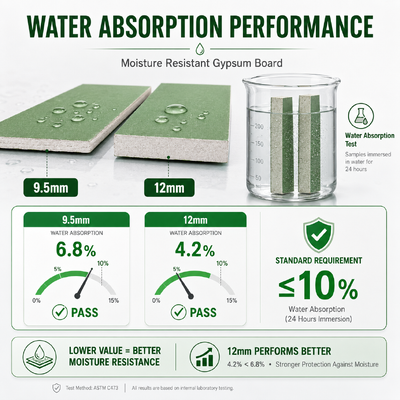
Moisture-resistant gypsum panels are designed for suitable humid interior environments, but moisture resistance alone does not make a wall system immune to mold.
Persistent condensation, hidden plumbing leaks, inadequate ventilation, wet wall cavities and long-term moisture exposure can create conditions very different from normal bathroom humidity.
When mold appears on a bathroom, hotel washroom or humid interior partition, buyers may immediately assume that the gypsum board failed. Visible mold, however, does not automatically identify the original moisture source.
The problem may come from persistent room humidity, condensation inside the wall cavity, plumbing leakage, direct-water exposure, incomplete joint protection or construction materials enclosed before they had dried sufficiently.
Steam remains inside the room for long periods instead of being removed after bathing, washing or cleaning.
Warm humid air can reach colder surfaces inside the wall cavity and create condensation even when the room-side face looks dry.
Slow leaks behind partitions can keep gypsum board, insulation or framing damp without obvious water on the finished wall.
Poorly protected corners, penetrations and unfinished joints can become local moisture entry points.
Repeated water spray creates a more demanding condition than normal interior humidity.
Closing a wall before framing, insulation or nearby materials have dried can trap moisture inside the assembly.
| Performance | What It Means | Buyer Should Understand |
|---|---|---|
| Moisture Resistance | Improved panel performance in suitable humid interior conditions. | It does not mean the board can remain continuously wet. |
| Mold Resistance | A separate performance characteristic when specifically tested or stated. | Do not assume every moisture-resistant panel provides the same mold-resistance performance. |
| Waterproofing | A wall-system function used where water penetration must be controlled. | Moisture-resistant plasterboard alone should not automatically be treated as a waterproof barrier. |
| Ventilation | Removes humid air and helps surfaces dry after use. | Even a suitable board may remain damp when ventilation is inadequate. |
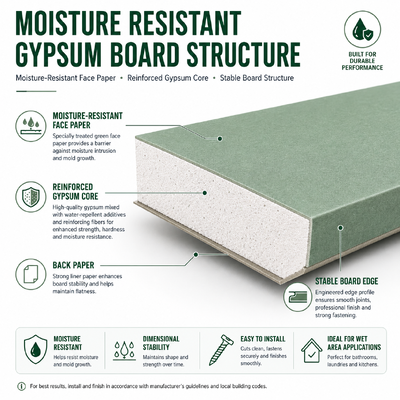
Paper facing is part of the complete gypsum panel structure and supports finishing, handling and surface integrity. In a correctly designed wall system, the facing should not remain persistently wet.
Risk increases when condensation, leakage or direct-water exposure keeps the face or wall cavity damp for long periods.
Replacing the board without correcting a leak, condensation problem or ventilation issue may allow the same damage to return.
One of the more difficult project problems occurs when the finished bathroom wall looks normal from the room side while moisture is accumulating behind the gypsum panel.
| Condition | Possible Result |
|---|---|
| Warm Humid Room Air | Moist air may enter openings, joints or wall cavities. |
| Cold Surface Inside Wall | Moisture can condense when humid air reaches a sufficiently cold surface. |
| Trapped Wall Cavity | Drying becomes slower when moisture cannot escape easily. |
| Repeated Humidity Cycles | Moisture may accumulate faster than the wall assembly can dry. |
Hotel bathrooms may experience repeated showers, frequent cleaning and shorter drying periods between occupants than many residential bathrooms.
For project buyers, the useful question is not only whether the board can be used in a bathroom, but whether the complete partition system matches expected occupancy and maintenance conditions.
| Hotel Condition | Purchasing Concern |
|---|---|
| Frequent Showers | More humidity cycles than many residential bathrooms. |
| Daily Cleaning | Walls and floors may experience repeated cleaning moisture. |
| High Occupancy | Wall systems may have less drying time between periods of use. |
| Air Conditioning | Temperature differences can influence condensation conditions within the assembly. |
| Visible Location | Possible Area to Investigate |
|---|---|
| Ceiling Corners | Ventilation, condensation and temperature differences. |
| Lower Wall Edge | Floor moisture, cleaning water or hidden leakage. |
| Around Plumbing | Pipe leakage, penetration sealing or pipe condensation. |
| Inside Wall Cavity | Hidden condensation, plumbing leakage or trapped construction moisture. |
| Shower Side of Wall | Direct-water exposure and the wet-area waterproofing system. |
Moisture-resistant gypsum board is an important part of many humid interior wall systems, but it is not the only factor controlling mold risk.
Buyers should consider the facing material, panel specification, ventilation, condensation conditions, waterproofing, plumbing and wall-cavity design together.
For hotel, apartment and commercial projects, identifying the actual moisture source helps buyers select a more appropriate wall system and reduces the risk of treating every humidity problem as a gypsum-board defect.
Send us your board thickness, panel size, wall or ceiling application, project type and expected humidity conditions. Suitable paper-faced gypsum panel specifications can be matched for washrooms, kitchens, hotel bathrooms and other humid interior spaces.
Request Wallboard Specification english
 français
 Deutsch
 Italiano
 Русский
 Español
 português
 Nederlandse
 ελληνικά
 日本語
日本語
 한국
한국
 العربية
 हिन्दी
 Türkçe
 indonesia
 tiếng Việt
 ไทย
ไทย
 বাংলা
বাংলা
 فارسی
فارسی
 polski