|
| Brand Name: | SUNHOUSE |
| Model Number: | 1220x244m-12mm |
| MOQ: | 800 |
| Payment Terms: | L/C,T/T |
Two moisture-grade gypsum panels can have the same green face, the same thickness and similar dimensions, yet behave very differently during cutting, fastening, handling and installation.
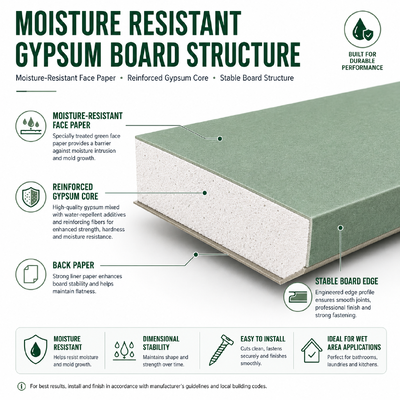
The difference is often hidden inside the panel: gypsum core consistency, face-to-core bonding, paper strength, edge formation and overall manufacturing control.
Some panel defects are difficult to see on a full sheet. Problems appear only after the board is cut, lifted, fixed to framing or exposed at the edge.
Buyers may then discover a soft core, excessive crumbling, paper peeling, weak corners or inconsistent edge shape. These are not simply appearance issues; they can affect installation efficiency and finished wall quality.
Check whether the core appears reasonably uniform, stable and free from obvious loose or severely broken areas.
Inspect surface strength, damage, wrinkles, contamination and consistency across multiple sheets.
Check whether paper remains firmly attached when the panel is cut, handled and lightly flexed.
Inspect tapered or square edges for shape consistency, damage resistance and clean finishing.
| Inspection Point | Better Controlled Panel | Possible Warning Sign |
|---|---|---|
| Core Texture | More uniform internal appearance | Loose, severely crumbly or irregular areas |
| Paper Bond | Paper stays attached to the gypsum body | Paper lifts or peels easily from the edge |
| Edge Breakage | Controlled breakage during normal handling | Large chunks break away too easily |
| Thickness | Reasonably consistent across the sheet | Large visible thickness variation |
Buyers sometimes judge a gypsum panel only by whether the core looks hard or dense. Core consistency matters, but a harder-looking sample is not automatically the best product for every project.
The complete panel should balance core structure, paper adhesion, thickness control, edge quality and the required project performance.
A board with strong core appearance can still create problems if paper bonding, edge formation or thickness consistency is poor.
Edge type is not only a specification name. Buyers should also inspect whether the edge profile is consistent across the sheet and across the production batch.
| Edge Issue | Why It Matters |
|---|---|
| Uneven Taper | Can make joint finishing less consistent across long wall runs. |
| Weak Corners | Can increase handling damage before installation. |
| Paper Lifting | May require repair or trimming before joint treatment. |
| Edge Thickness Variation | Can affect alignment between adjacent sheets. |
During installation, screws compress the paper facing and gypsum core locally. The finished result depends on correct installation, but panel quality also affects how cleanly the surface behaves around the fixing point.
Buyers can compare sample panels using consistent screw type, framing and installation settings to observe whether the paper tears excessively or the local core breaks too easily.
For moisture-grade gypsum panels, the visible face is only one part of the product. Core structure, paper adhesion, edge formation and dimensional consistency all influence how the board performs during handling and installation.
Buyers should inspect fresh cut edges, compare several sheets and review the exact product specification instead of relying only on color, nominal thickness or a single selected sample.
This makes supplier comparison more practical and helps identify hidden quality differences before the material reaches the jobsite.
Send us your required thickness, board size, edge type, project application and moisture-grade requirement. Suitable gypsum panel specifications can be matched according to the required core, facing and installation performance.
Request Panel Specification english
 français
 Deutsch
 Italiano
 Русский
 Español
 português
 Nederlandse
 ελληνικά
 日本語
日本語
 한국
한국
 العربية
 हिन्दी
 Türkçe
 indonesia
 tiếng Việt
 ไทย
ไทย
 বাংলা
বাংলা
 فارسی
فارسی
 polski