|
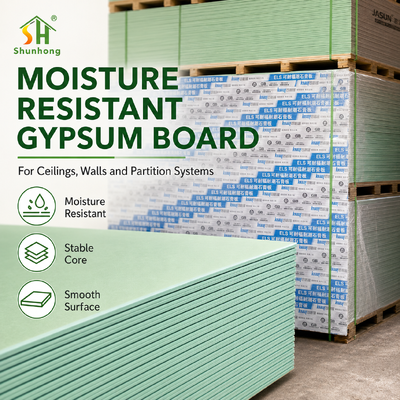
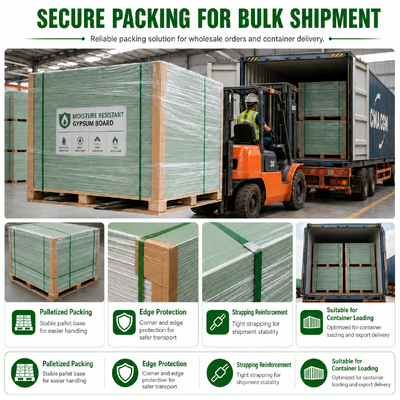
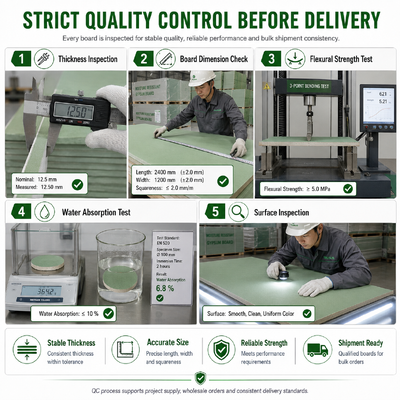
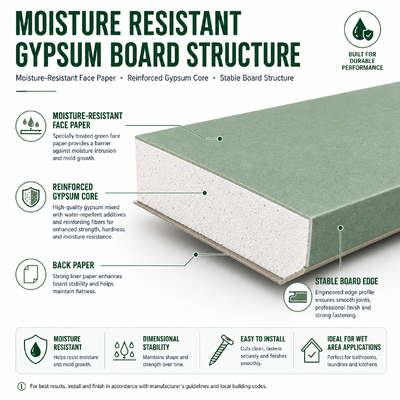
| Brand Name: | SUNHOUSE |
| Model Number: | 1220x244m-12mm |
| MOQ: | 800 |
| Payment Terms: | L/C,T/T |
Hotel bathrooms, washroom partitions, corridors and service shafts may require more than one type of gypsum-board performance. Moisture exposure may be important on one side of the wall, while the complete partition may also need a specified fire-resistance level.
These are separate project requirements. A moisture-resistant board should not automatically be assumed to provide the required fire performance, and a fire-resistant board should not automatically be assumed to provide the required moisture performance.
This is common in hotels, apartments and commercial interiors. The bathroom-facing side of a partition may need moisture resistance, while the corridor or service wall may also form part of a fire-resisting construction.
If the buyer checks only the board name, an important system requirement may be missed. The specification should identify the required board type and the tested wall, shaft or ceiling assembly.
Is the board intended for humid interior walls, bathroom-facing partitions, washrooms or other areas where moisture exposure is higher than standard dry rooms?
Does the complete partition, shaft or ceiling need to achieve a specified fire-resistance rating using a tested or approved construction?
| Term | What Buyers Should Understand | What to Confirm |
|---|---|---|
| Fire-Resistant Gypsum Board | Describes a board with specified fire-related characteristics. | Board type, thickness and applicable product standard |
| Fire-Rated Wall Assembly | The fire-resistance result applies to a complete tested construction. | Studs, board layers, thickness, fasteners, insulation, joints and assembly design |
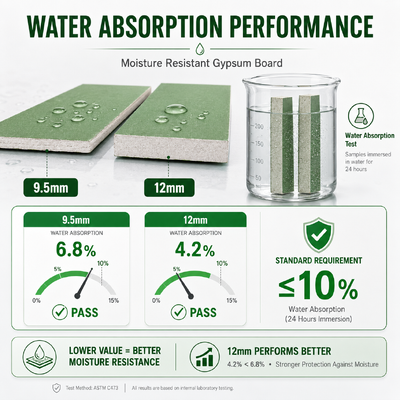
| Moisture-Resistant Board | Designed for suitable humid interior conditions according to the product specification. | Moisture classification, application and supporting test information |
| Dual-Performance Board | Some products are specifically designed to provide both fire and moisture-related properties. | Confirm that both properties are documented for the exact product |
Fire resistance depends on the complete assembly and the referenced tested design.
A partition between a bathroom and corridor can experience humidity on one side and fire-performance requirements from the corridor or compartmentation strategy on the other.
| Partition Location | Moisture Concern | Other Possible Requirement |
|---|---|---|
| Bathroom to Bedroom | Bathroom-side humidity | Acoustic separation |
| Bathroom to Corridor | Humidity and cleaning exposure | Fire and acoustic requirements may apply |
| Bathroom Service Wall | Humidity plus plumbing penetrations | Service-shaft fire protection may be required |
| Plant / Utility Room Wall | Possible humidity or service leakage | Fire separation, impact or acoustic performance |
Shafts can contain pipes, ducts and building services. Their wall construction may need defined fire performance, while plumbing and condensation can also create local moisture exposure.
The buyer should therefore request the exact shaft-wall construction instead of substituting boards based only on similar thickness or color.
Board thickness is important, but fire performance is not determined by thickness alone. A tested assembly may use specific board types, multiple layers, defined framing and particular fastening arrangements.
Changing one component without checking the referenced design can change the status of the complete assembly.
Some manufacturers offer plasterboards specifically classified for both fire and moisture-related performance. These products can be useful where one wall location requires both functions, provided the exact board and complete assembly meet the project specification.
For example, current British Gypsum FireLine MR products are identified as Type F and H1 under BS EN 520, showing that fire and moisture properties can be combined in one documented product. The project still needs the correct system design for the required fire resistance.
Hotel bathrooms, corridors and service shafts can require several performance characteristics in one partition system. Buyers should avoid assuming that one board name automatically satisfies every requirement.
First define the humidity exposure. Then define the required fire resistance of the wall, shaft or ceiling. Finally, confirm that the proposed board and full assembly are supported by the appropriate product and system documentation.
This approach reduces substitution risk and makes supplier quotations easier to compare on the same technical basis.
Send us your required board size, thickness, wall location, humidity exposure and fire-performance requirement. Suitable gypsum panel options can be matched to the intended interior partition system.
Request Project Board Specification english
 français
 Deutsch
 Italiano
 Русский
 Español
 português
 Nederlandse
 ελληνικά
 日本語
日本語
 한국
한국
 العربية
 हिन्दी
 Türkçe
 indonesia
 tiếng Việt
 ไทย
ไทย
 বাংলা
বাংলা
 فارسی
فارسی
 polski